Army Body Fat Calculator
The Army replaced body fat measurement with waist-to-height ratio on 7 July 2026. Divide your waist at the navel by your height; below 0.55 passes.
Army Body Composition Calculator
How the Army scores body composition now
Divide your waist measurement at the navel by your height in the same unit. Below 0.55 passes. That single ratio is the whole assessment. Age does not shift it, sex does not shift it, and your weight is not part of the arithmetic at all.
The Army published this in Army Directive 2026-13 and it took effect on 7 July 2026. If you were assessed before that date, you were screened against the height and weight tables first and taped only if you exceeded them. Both of those steps are gone.
What the directive replaced
Three separate things disappeared at once, which is why searches for the old methods still outnumber searches for the new one.
| Before | From 7 July 2026 |
|---|---|
| Height and weight screening tables by age and sex | Removed |
| Circumference tape test: neck, waist, and hip for women | Removed |
| Supplemental methods such as DEXA, Bod Pod and hydrostatic weighing | Removed |
| Nothing equivalent | Waist-to-height ratio below 0.55 |
One consequence catches people out. Under the tape test, a tall soldier with a thick neck scored better, because neck circumference was subtracted from waist circumference. The neck no longer helps. A second: the old tables let a heavier soldier pass on weight alone if they came in under the screening figure for their height and age. Weight is now irrelevant, so a 230 lb soldier with a 38 inch waist at 6 ft 2 in passes comfortably while a 175 lb soldier with the same waist at 5 ft 7 in does not.
Largest passing waist for your height
Every figure below is the height multiplied by 0.55. The standard is below the threshold, so a measurement landing exactly on these numbers does not pass.
| Height | Height (cm) | Waist limit (in) | Waist limit (cm) |
|---|---|---|---|
| 5 ft 0 in | 152.4 | 33.0 | 83.8 |
| 5 ft 2 in | 157.5 | 34.1 | 86.6 |
| 5 ft 4 in | 162.6 | 35.2 | 89.4 |
| 5 ft 6 in | 167.6 | 36.3 | 92.2 |
| 5 ft 8 in | 172.7 | 37.4 | 95.0 |
| 5 ft 10 in | 177.8 | 38.5 | 97.8 |
| 6 ft 0 in | 182.9 | 39.6 | 100.6 |
| 6 ft 2 in | 188.0 | 40.7 | 103.4 |
| 6 ft 4 in | 193.0 | 41.8 | 106.1 |
Worked example: 5 ft 10 in and a 36 inch waist
5 ft 10 in is 70 inches. 36 ÷ 70 = 0.514, which is under 0.55, so it passes. The limit at that height is 70 × 0.55 = 38.5 inches, leaving 2.5 inches of margin.
In centimetres the answer is identical, because the ratio has no units: 91.4 ÷ 177.8 = 0.514. That is the point of a ratio standard. There is no conversion step where a rounding error can change a pass into a fail.
Measuring the waist so the number means something
Placement is the whole game here, and at these tolerances a sloppy tape costs more than a month of training. Half an inch of tape drift moves the ratio by about 0.007, and plenty of soldiers sit within 0.007 of the line.
- Measure at the navel, not at the narrowest point of the torso and not at the belt line.
- Keep the tape level all the way round. A tape that rides up at the back reads short at the front.
- Snug against the skin without compressing it. If the tape leaves a mark, it is too tight.
- Read at the end of a normal exhale. Holding your breath in is the most common way people produce a number they cannot repeat.
- Measure first thing in the morning if you are comparing week to week. A large meal is worth an inch on some people.
Height matters more than people expect, because it sits in the denominator. An inch of height is worth about 0.008 on the ratio at typical adult sizes, which is larger than the effect of half an inch of waist. Stand tall, heels together, no shoes.
What a failed assessment actually triggers
Coming in at or above 0.55 starts a confirmation measurement the same day, and passing that confirmation ends the matter. A confirmed failure opens a 180-day validation period. The directive attaches no separations for body composition to that window, so the outcome is a plan and a re-measure rather than a discharge. Assessment happens twice per calendar year.
Your chain of command and the current regulation decide what applies to you. This page is a calculator and a reading of a public directive, nothing more.
Where this stops being useful
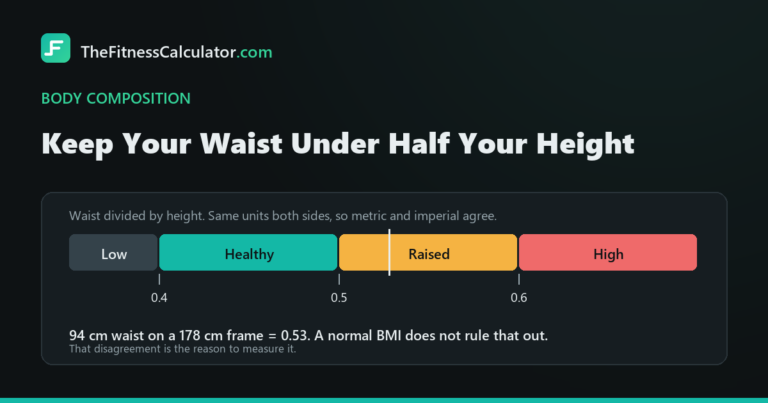
Waist-to-height is a screening ratio. It tracks abdominal fat well across large groups, which is why it has been in the general health literature for years and why the waist-to-height ratio guide covers the civilian 0.5 threshold. It still cannot distinguish a thick abdominal wall from visceral fat, and it says nothing about how much muscle you carry.
It also does not measure fitness. Body composition and the fitness test are separate assessments with separate standards, and passing one tells you nothing about the other.
The 0.55 figure is an Army number. If you are in another branch, use the standard you are assessed against. For a general civilian reading, the body fat percentage calculator runs the Navy circumference method, and the BMI calculator scores weight against height on the adult bands.
Common questions
What is the Army body fat standard in 2026?
There is no body fat standard any more. Army Directive 2026-13 took effect on 7 July 2026 and replaced body fat measurement with waist-to-height ratio. Divide your waist at the navel by your height in the same unit. Anything below 0.55 passes. Age, sex and weight no longer change the number you have to beat.
Did the Army get rid of the tape test?
Yes. The circumference tape test that used neck, waist and, for women, hip measurements is gone, along with the height and weight screening tables and the supplemental methods such as DEXA and the Bod Pod. One waist measurement and your height now decide the assessment.
Where exactly is the waist measured?
At the navel, with the tape level all the way round and snug without compressing the skin. Measure at the end of a normal exhale rather than holding your breath in. A half-inch of tape placement is worth about 0.007 on the ratio, which matters when you are close to the line.
What waist passes at my height?
Multiply your height by 0.55. At 5 ft 8 in, 68 inches, the limit is 37.4 inches. At 5 ft 10 in it is 38.5 inches, at 6 ft 0 in it is 39.6 inches, and at 5 ft 4 in it is 35.2 inches. The calculator prints the figure for your exact height.
How often is the assessment done?
Twice per calendar year. A soldier who comes in at or above 0.55 gets a confirmation measurement the same day, and passing the confirmation ends it there.
What happens if you fail the Army body composition assessment?
A failed assessment starts a 180-day validation period. Under the directive that window carries no separations for body composition, so the outcome is a plan and a re-measure rather than a discharge. Your unit and the current regulation are the authority on what your own case requires, not this page.
Does this calculator work for the Navy, Air Force or Marines?
No. The 0.55 threshold is an Army standard. The Navy still runs its own circumference method, the Air Force uses a waist measurement scored against its own table, and the Marine Corps keeps a height and weight screen with a tape backup. Use the branch standard you are actually assessed against.
Written and maintained by Rowan Hale, the site author’s pen name. Published September 20, 2026 against Army Directive 2026-13. No military or medical qualification is claimed. Read our editorial policy or report a calculation error.
The other calculators
They all run together on the health and fitness calculator hub.