Macro Calculator
Daily protein, carbohydrate and fat in grams, built from your own maintenance calories. Protein set per kilogram of body weight rather than as a share of the total, with the arithmetic shown at every step.
Macro Calculator
Grade the whole week, job and commute included. Pick the lower band when you sit between two.
Only used to divide the daily totals. Absorption does not stop at a fixed number of grams per sitting.
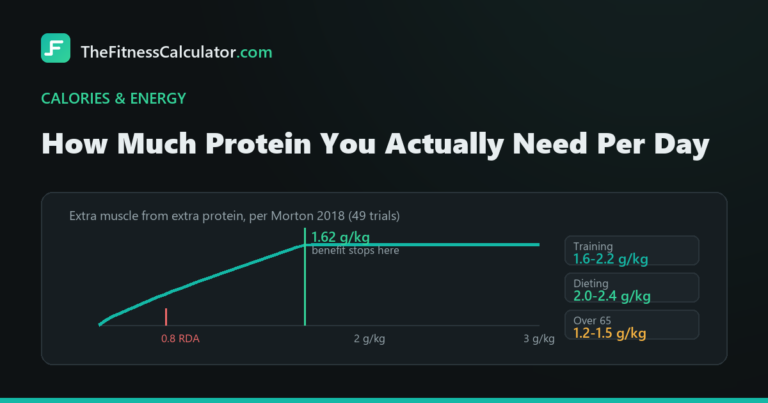
1.6 is the breakpoint Morton and colleagues found in 2018. Lifters cutting hard often run 2.0 to 2.4.
0.5 g/kg is about the floor for hormone production and fat-soluble vitamins. Carbohydrate takes whatever calories are left.
The same numbers, broken down
| Macro | Grams/day | Calories | % of total | Per meal |
|---|---|---|---|---|
| Protein | – | – | – | – |
| Carbohydrate | – | – | – | – |
| Fat | – | – | – | – |
| Total | – | – | – |
An 80 kg man eating 2,400 calories a day can run 200 g of protein and 40 g of carbohydrate, or 100 g of protein and 350 g of carbohydrate. Both add up to 2,400. Both hold his weight steady. What changes between them is how much muscle he keeps while dieting, how hungry he gets at four in the afternoon, and whether his fifth set still feels like his first.
How the calculator gets there
Four steps, in order. Resting metabolic rate comes from the Mifflin-St Jeor equation, published in the American Journal of Clinical Nutrition in 1990 and still the closest predictor of measured resting expenditure for most adults. Multiply that by an activity factor between 1.2 and 1.9 for total daily energy expenditure. Apply your goal as a percentage of that figure. Divide what is left into grams.
Take a 30-year-old man, 80 kg, 180 cm, training four days a week. Mifflin-St Jeor gives 800 + 1,125 − 150 + 5 = 1,780 kcal at rest. At a 1.55 multiplier his maintenance is 2,759. A 20 percent cut puts him on 2,207. Protein at 1.6 g/kg is 128 g, which costs 512 kcal. Fat at 0.8 g/kg is 64 g, costing 576. That leaves 1,119 kcal, so carbohydrate lands at 280 g.
Every figure the panel prints is that same calculation with your numbers in it. The TDEE calculator stops at the 2,759 and shows the resting and activity halves separately.
Protein first, because it is the one with a number attached
Morton and colleagues pooled 49 studies of protein supplementation and resistance training in 2018 and found gains in lean mass flattening out near 1.62 g per kilogram per day. The interval around that estimate is wide, so read it as a region rather than a line. At 80 kg it comes to about 130 g.
In a deficit the figure goes up. Protein is what keeps a cut from taking muscle alongside fat, and the trials that get the best body-composition results while restricting calories run 2.0 to 2.4 g/kg with resistance training attached. The recomposition page sets out the conditions those trials imposed, which were not gentle ones.
The default here is 1.6. Raise it toward 2.2 if you are cutting and lifting. Healthy adults show no harm at these intakes in the research that exists, and the protein guide works through what that research covers and what it does not.
Fat has a floor, and carbohydrate takes what is left
Below roughly 0.5 g per kilogram, fat intake starts to interfere with sex hormone production and with absorbing vitamins A, D, E and K. Treat that as the floor. Somewhere between 0.8 and 1.0 g/kg is a more comfortable place to sit. Above the floor, the split between fat and carbohydrate comes down to preference: controlled trials that hold calories and protein equal find low-carb and low-fat diets producing much the same fat loss.
Carbohydrate takes the remainder, which means it absorbs your whole deficit. Our 80 kg man eats 418 g at maintenance, 280 g on a 20 percent cut and 211 g on a 30 percent cut. Protein and fat barely shift across all three. That is deliberate, and it is also why training sessions feel noticeably flatter the deeper a cut runs.
The percentage presets drift, and the drift matters
40/30/30, 30/35/35, the ketogenic 25/5/70: each one sets protein as a share of calories, so your protein target moves every time your calories move. Thirty percent of 2,759 kcal is 207 g of protein. Thirty percent of 1,931 kcal is 145 g. Same percentage, same man, 62 g apart, and the smaller figure arrives at exactly the point in a cut where protein matters most.
The presets are on the page because readers arrive looking for them and because a ratio is easy to carry in your head. Setting protein per kilogram of body weight is the better method. Choose a preset for the convenience if you want, knowing what the convenience costs.
Grams per meal, and how precise to be
Dividing the day by three or four is arithmetic rather than physiology. Spreading protein through the day shows a small advantage for muscle protein synthesis in the research, measured in single-digit percentages, and no study has found a per-sitting ceiling that bites at ordinary meal sizes. Eat on whatever schedule fits your day.
Precision past about 10 g on protein and fat, or 20 g on carbohydrate, buys nothing. US food labels are allowed a 20 percent margin on these values, and two chicken breasts from the same shop differ by more than that. Hit your protein most days, keep fat above the floor, and let carbohydrate land where it lands.
Where this stops
None of this accounts for fibre, micronutrients, food quality, alcohol, or the conditions that change the whole picture. Kidney disease, pregnancy, diabetes and disordered eating need individual advice rather than a calculator. The deficit guide covers how far a cut can reasonably go before the plan itself becomes the problem.
Scope and correction note, 1 October 2026: The Mifflin-St Jeor equation and the protein meta-analysis linked below are published research; the activity multipliers and the preset ratios are calculator conventions rather than measured values. Nothing here is medical or dietetic advice. See the editorial policy and medical disclaimer.
Common questions
What are macros?
Protein, carbohydrate and fat, the three nutrients you eat in gram quantities rather than milligrams. Protein and carbohydrate carry 4 kcal per gram and fat carries 9, so a 2,000 kcal day can be divided hundreds of ways and still come to 2,000. The total decides whether you gain or lose. The split decides how much of the change is muscle and how the dieting feels.
What is the best macro split for fat loss?
Set protein first, 1.6 to 2.2 g per kg of body weight. Keep fat at or above 0.5 g/kg. Let carbohydrate take whatever calories are left. For an 80 kg person eating 2,000 kcal that comes out near 160 g protein, 60 g fat and 185 g carbohydrate. Trials that hold calories and protein equal find very little between low-carb and low-fat, so the honest answer is the one you can keep doing in week nine.
How much protein do I need a day?
Morton and colleagues pooled 49 resistance-training studies in 2018 and put the point of diminishing returns near 1.62 g per kg per day, with wide uncertainty either side. At 80 kg that is about 130 g. People in a deficit often run 2.0 to 2.4 g/kg, because protein is what protects lean mass when calories are short.
How many carbs should I eat a day?
Whatever is left after protein and fat, which for most people lands between 2 and 5 g per kg. An 80 kg person eating 2,500 kcal with 160 g protein and 70 g fat has 1,230 kcal spare, about 305 g of carbohydrate. Cut the same person to 1,900 kcal and the spare drops to 630 kcal, about 155 g. Carbohydrate is the macro that absorbs the deficit.
Do I have to hit my macros exactly?
No. Within 10 g on protein and fat and 20 g on carbohydrate is close enough, and the food labels you are working from carry more error than that. Hitting your protein target four days out of five matters. The last 5 g of carbohydrate does not.
How do I calculate macros by hand?
Work out your maintenance calories, apply your deficit or surplus, then multiply your weight in kilograms by your protein and fat targets. Protein grams times 4 plus fat grams times 9 gives what those two cost. Subtract that from your target and divide by 4 for carbohydrate grams. An 80 kg person on 2,200 kcal at 1.6 and 0.8 g/kg: 128 g protein and 64 g fat cost 1,088 kcal, leaving 278 g of carbohydrate.
What macros should I eat to build muscle?
A surplus of 10 to 20 percent over maintenance, protein at 1.6 to 2.2 g/kg, fat around 0.8 to 1.0 g/kg, and carbohydrate filling the rest. The carbohydrate fuels the training that causes the growth, which makes it the worst place to economise while you are trying to add size.
Should I cut carbs or fat when dieting?
Whichever you miss less. Below roughly 0.5 g/kg of fat, hormone production and fat-soluble vitamin absorption start to suffer, so treat that as the floor. Above it, preference wins. Someone training five hard days a week usually keeps the carbohydrate and trims fat. Someone who gets hungry on a high-carb day does the opposite and is equally right.
Does hitting my macros matter more than counting calories?
Calories set the direction. A 500 kcal surplus adds weight whether carbohydrate makes up 40 percent of it or 10. What the split changes is how much of the gain is muscle, how full you feel between meals, and whether your training holds up in the fourth week.
The other calculators
They all run together on the health and fitness calculator hub.
Read the reasoning
 How Much Protein You Actually Need Per DayPut protein research ranges in context, calculate an example intake, and understand why study averages are not personal prescriptions.
 How Big Should a Calorie Deficit Be?Compare calorie-deficit examples and learn why fixed calorie rules cannot promise a weekly weight-loss result.