Waist to Height Ratio: Keep Your Waist Under Half Your Height
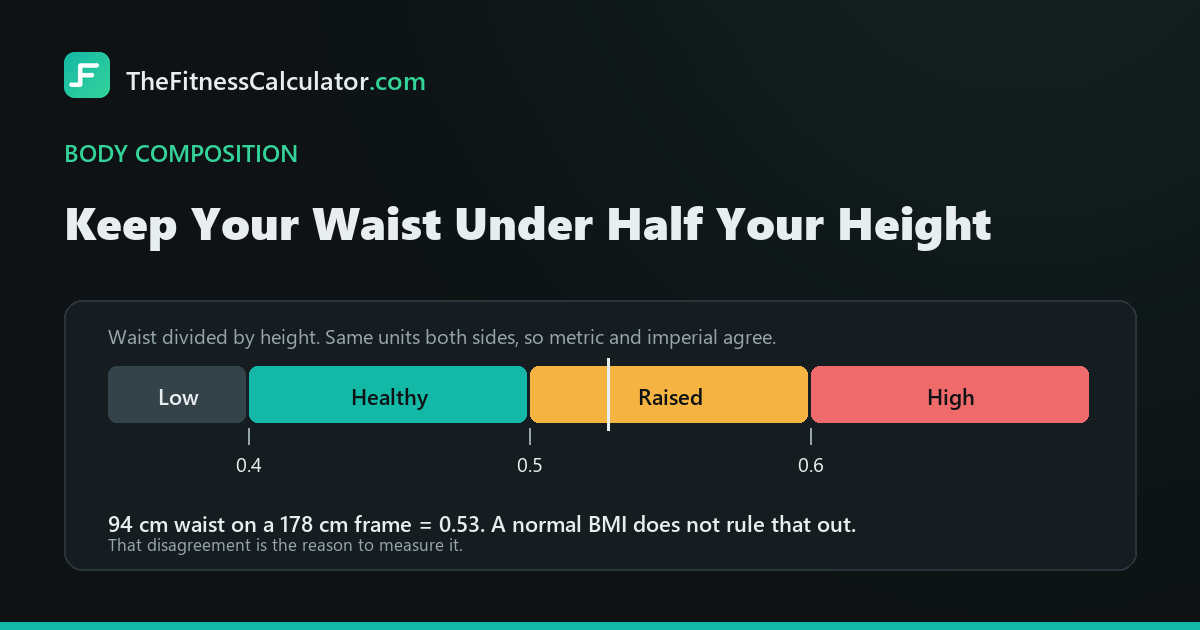
Divide your waist circumference by your height. If the answer is under 0.5, your waist is less than half your height and you are on the right side of the screening threshold. That is the whole method. It needs a tape measure and no equipment, it uses the same units on both sides so metric and imperial give the same answer, and it outperforms BMI at the job BMI is usually asked to do.
Why it beats the number on the chart
BMI weighs you and squares your height. It has no way of knowing whether the mass is muscle or fat, or where the fat sits, which is where BMI falls apart. Waist to height ratio measures one specific thing: how much you are carrying around the middle, scaled to your frame.
That distinction matters because abdominal fat carries the risk. A 2012 systematic review and meta-analysis in Obesity Reviews compared the screening tools directly and found waist to height ratio was a better discriminator than both waist circumference and BMI for diabetes, hypertension, high cholesterol and cardiovascular outcomes. A follow-up in BMJ Open in 2016 made the case that a single boundary at 0.5 is simpler and more predictive than the grid of BMI and waist categories clinicians had been using.
The UK’s National Institute for Health and Care Excellence updated its obesity guidance in 2022 to recommend waist to height ratio alongside BMI for adults with a BMI under 35, which is the same conclusion arriving through a different door.
The bands
- Under 0.4. Below the healthy range for most adults. Worth a conversation with a doctor rather than a celebration.
- 0.4 to 0.49. Healthy. No action needed.
- 0.5 to 0.59. Increased risk. This is where most people who feel fine sit.
- 0.6 and above. Substantially increased risk.
Worked example. A man of 178 cm with a 94 cm waist gets 94 divided by 178, which is 0.53. He may well sit inside a normal BMI band at that size. The ratio flags him anyway, and the ratio is right.
Measuring the waist so the number means something
Most of the error in this method comes from tape placement, the same way it does with the Navy tape method.
- Measure against bare skin, standing, feet together.
- Use the midpoint between the bottom of your lowest rib and the top of your hip bone. If you cannot find those, the navel is a workable substitute as long as you use it every time.
- Keep the tape horizontal and snug without compressing the skin.
- Breathe out normally and read at the end of the exhale. Do not suck in, and do not push out.
- Take the measurement first thing in the morning, before eating.
Repeat three times and average. A centimetre of tape error moves the ratio by about 0.006, which is small, but only if you are consistent about where the tape goes.
What the threshold does not know
The 0.5 boundary is a screening line, not a diagnosis. It comes from population data, and populations contain people it fits badly.
Pregnancy makes the measurement meaningless. Very tall and very short adults sit at the edges of the data the boundary was derived from. Some evidence suggests South and East Asian populations carry more visceral fat at a given waist size, so a threshold slightly below 0.5 may suit better. And a heavily muscled lifter with a thick torso can push the ratio up without carrying much abdominal fat, though this is rarer than the people claiming it would suggest.
Use it alongside the other numbers, not instead
Waist to height ratio tells you about central fat. It says nothing about your total body composition, your fitness or your strength. Run it monthly next to the BMI calculator and a body fat estimate, and treat any disagreement between them as information rather than a problem. A normal BMI with a ratio of 0.55 means the weight is fine and the distribution is not, and the distribution is the part that shows up in bloodwork. What the ratio tracks is the fat packed around your organs, which is the tissue doing the damage.
The measurement responds quickly, too. Abdominal fat is among the first tissue to move in an energy deficit, so a waist that has dropped 2 cm over eight weeks is real progress even on a week when the scale has not budged. The other calculator guides cover the measurements worth taking alongside it.