TDEE Calculator
Work out what you burn in a day, not what you should eat. Mifflin-St Jeor resting estimate, an activity multiplier you pick yourself, and the arithmetic shown at every step.
TDEE Calculator
How this TDEE calculator works
Total daily energy expenditure is everything you burn in twenty-four hours. Staying alive accounts for most of it. Walking to the kitchen, holding your temperature, digesting lunch and whatever training you did all sit on top.
The calculator does it in two steps. First it estimates resting energy expenditure from the Mifflin-St Jeor equations published in 1990, using weight in kilograms, height in centimetres and age in years:
- Male: 10 × weight + 6.25 × height − 5 × age + 5
- Female: 10 × weight + 6.25 × height − 5 × age − 161
Then it multiplies that resting figure by an activity factor. The product is your TDEE. The screen labels the resting number BMR, which is the usual calculator convention. Strictly the equation predicts resting energy expenditure, and a true basal measurement needs a lab, an overnight fast and no movement beforehand. The gap is small, but the label is worth knowing about.
Pick your activity level honestly
This is where the estimate goes wrong, and it goes wrong in one direction. People grade themselves a band high. Four gym sessions is about four hours out of a 168-hour week, so what you do with the other 164 decides the multiplier.
| Level | Multiplier | Who it fits |
|---|---|---|
| Sedentary | 1.2 | Desk job, car or train commute, no structured training. |
| Light | 1.375 | Desk job plus one to three sessions, or a job on your feet. |
| Moderate | 1.55 | Three to five sessions a week and a reasonably active day. |
| Active | 1.725 | Six or seven sessions, or hard training on top of manual work. |
| Very active | 1.9 | Physical trade plus training, or twice-daily sessions. |
Between two bands, take the lower one. An estimate that is 150 calories light shows up as slower progress you can correct. One that is 400 calories heavy looks like a plateau you cannot explain. The activity multiplier guide goes through each band with examples.
Worked example: 70 kg, 175 cm, 30 years old
Male equation: (10 × 70) + (6.25 × 175) − (5 × 30) + 5, which is 700 + 1,093.75 − 150 + 5 = 1,648.75 calories at rest. At a moderate multiplier of 1.55 that becomes 2,555.6 calories a day. The calculator rounds to 1,649 and 2,556.
Change one thing and watch what moves. Drop to sedentary and the same man burns 1,978. Push to active and he burns 2,844. The multiplier swings the answer by 866 calories while the resting figure never budges, which is why the band you pick matters more than the decimals in your height.
What to do with the number
Eat at your TDEE and weight holds. Everything else is that figure with an offset. Roughly 500 below it loses about a pound a week. Around 300 above it gains slowly enough that most of the gain is lean tissue. How big a calorie deficit should be covers why bigger is not better.
Treat the output as a hypothesis rather than a measurement. Eat at it for two weeks, weigh yourself daily and average each week. If the average is flat, the number was right. If you lost half a kilo, your real TDEE is about 350 higher than the estimate. That two-week correction beats any formula, because it measures you instead of predicting the average of a study population.
If what you want is a daily intake target rather than the expenditure figure, the calorie calculator runs the same equation and prints loss, maintenance and gain targets side by side.
Your TDEE does not stay put
A smaller body is cheaper to run. Lose 10 kg and resting expenditure falls by roughly 100 calories a day, before you count the extra drop from moving less mass around. This is the honest answer to why month four stalls when month one did not, and it is not a broken metabolism.
Recalculate every 5 kg. Age matters far less than people expect: the equation subtracts 5 calories per year, so a decade costs 50 calories a day. Body composition does more, since muscle costs more to maintain than fat does. BMR and TDEE compared works through which parts you can change and which you cannot.
Common questions
What does a TDEE calculator actually tell you?
The calories you burn across a full day, sleep and fidgeting and training included. Eat that number and your weight holds. Every diet target is that figure plus or minus an offset, which makes it the first thing worth knowing and the thing most people never work out.
How accurate is a TDEE calculator?
The resting half is solid. Mifflin-St Jeor lands within about 10 percent of measured resting expenditure for most adults. The activity multiplier is the loose half, because you are grading your own week. Two weeks of weight data will tell you more than any calculator can.
Does your TDEE fall as you lose weight?
Yes. A 90 kg body costs more to run than an 80 kg one, so the deficit that produced a pound a week at the start produces less later. Recalculate every 5 kg rather than holding the original figure all the way down.
Should you eat your TDEE on rest days?
Most people should. The multiplier already averages training across the week, so cutting hard on rest days double-counts the days you did not train. Matching intake to each individual day works too, but it is more effort for the same weekly total.
Is TDEE the same as maintenance calories?
Yes, two names for one number. Clinical and research writing says total daily energy expenditure. Diet apps say maintenance. If a plan tells you to eat at maintenance, it means eat at your TDEE.
The short version
Resting burn from an equation, multiplied by an activity band you choose. The equation is dependable and the band is a guess, so pick the lower one and let two weeks of weight data correct it.
Scope and correction note, 19 September 2026: the Mifflin-St Jeor equations come from the 1990 study linked above, and the activity multipliers are long-standing calculator conventions rather than measured values from that study. All of it describes averages, not you. Nothing on this page is medical advice. If a figure here is wrong, tell us and we will correct it and date the correction.
The other calculators
They all run together on the health and fitness calculator hub.
Read the reasoning
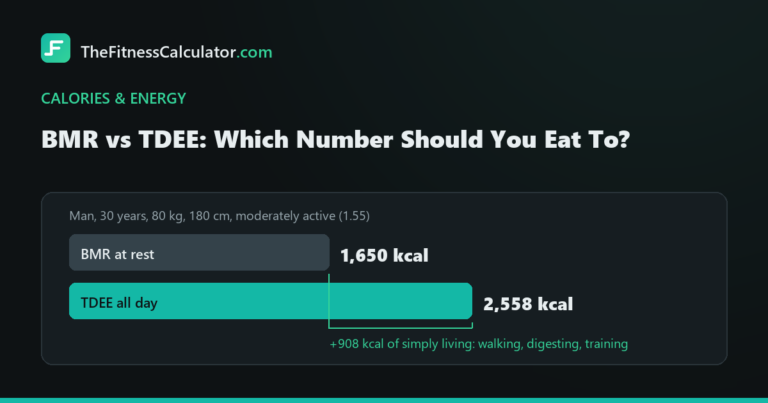 BMR vs TDEE: Which Number Should You Actually Eat To?Understand estimated resting energy, daily expenditure and calorie scenarios without treating BMR as a personal minimum intake.
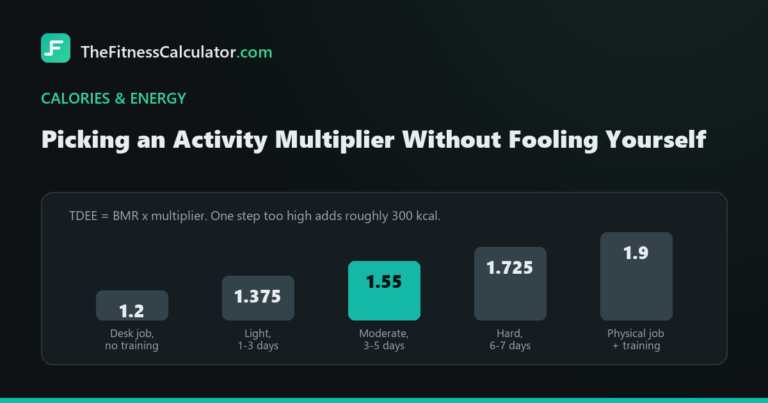 Picking an Activity Multiplier Without Fooling YourselfSee how activity multipliers change TDEE, why step counts are only context, and how to avoid counting exercise twice.