How much water you need a day
The calculator uses 35 ml per kilogram of body weight, plus about 350 ml for every 30 minutes of exercise. A 70 kg adult who trains for half an hour lands near 2.8 litres, which is 12 cups or 95 fluid ounces.
Scaling by body weight is the part that matters. A 55 kg woman and a 95 kg man do not need the same intake, and every fixed-number rule ignores that. Bigger bodies hold more water, lose more through skin and breath, and run larger kidneys.
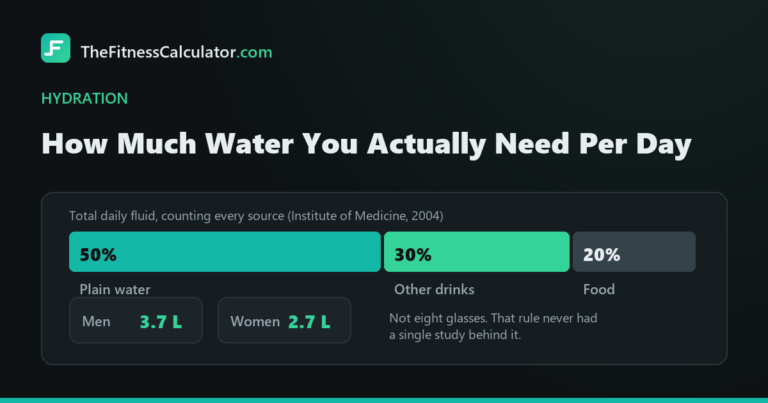
The US National Academies put total daily water at 3.7 litres for men and 2.7 litres for women, which sounds higher than the figure above until you notice they count everything: food, tea, coffee, juice, soup. Roughly 20 percent of the total arrives as food.
Daily water intake by weight
| Body weight |
Sedentary |
30 min exercise |
60 min exercise |
| 50 kg / 110 lb |
1.8 L / 7 cups |
2.1 L / 9 cups |
2.5 L / 10 cups |
| 60 kg / 132 lb |
2.1 L / 9 cups |
2.5 L / 10 cups |
2.8 L / 12 cups |
| 70 kg / 154 lb |
2.5 L / 10 cups |
2.8 L / 12 cups |
3.2 L / 13 cups |
| 80 kg / 176 lb |
2.8 L / 12 cups |
3.2 L / 13 cups |
3.5 L / 15 cups |
| 90 kg / 198 lb |
3.2 L / 13 cups |
3.5 L / 15 cups |
3.9 L / 16 cups |
| 100 kg / 220 lb |
3.5 L / 15 cups |
3.9 L / 16 cups |
4.2 L / 18 cups |
Heat and humidity push these figures up sharply, and so does altitude above about 2,500 m. Pregnancy adds around 300 ml a day and breastfeeding around 700 ml. Fever, vomiting and diarrhoea all raise the requirement while making it harder to meet.
How many ounces of water per day
The same figures in US units, since most people ask the question in ounces rather than litres. One US cup is 8 fl oz, so a 16.9 fl oz bottle is a little over two cups.
| Body weight |
Sedentary |
30 min exercise |
60 min exercise |
| 110 lb |
59 oz |
71 oz |
83 oz |
| 130 lb |
70 oz |
82 oz |
93 oz |
| 150 lb |
81 oz |
92 oz |
104 oz |
| 170 lb |
91 oz |
103 oz |
115 oz |
| 190 lb |
102 oz |
114 oz |
126 oz |
| 210 lb |
113 oz |
125 oz |
136 oz |
| 230 lb |
123 oz |
135 oz |
147 oz |
The rate works out at 0.54 oz per pound, and each 30 minutes of training adds about 12 oz. A 150 lb office worker who walks the dog and nothing else needs somewhere near 81 oz, or just under five of the standard 16.9 oz bottles. Nobody hits that number exactly, and nobody needs to.
Half your body weight in ounces
This rule says a 160 lb person should drink 80 oz. It is popular because it is easy, and it lands close to the mark for someone who does not train: 0.5 oz per pound against the 0.54 the weight-scaled figure asks for, a difference of about 7 percent.
Exercise is where it comes apart. The rule takes no account of sweat, so the same 160 lb person doing an hour a day needs about 110 oz and the rule still says 80. That is a shortfall of about 27 percent, repeated daily, and thirst lags behind real fluid loss during training so it does not announce itself.
Treat half your body weight in ounces as a floor for a rest day rather than a target for every day. The calculator above starts from the same body-weight logic and then accounts for the training you actually did.
The eight glasses a day rule
Eight 240 ml glasses comes to 1.9 litres, or 64 oz. That is about right for a small, sedentary adult and well short for a large or active one, which is the problem with quoting it at everybody.
The rule appears to trace back to a 1945 US Food and Nutrition Board recommendation of 1 ml per calorie consumed, roughly 2.5 litres on a 2,500 kcal diet. The very next sentence said most of that quantity comes from prepared food. Everyone kept the number and dropped the sentence. How much water you actually need traces the rest of the trail.
What counts towards the total
Tea, coffee, milk, juice and soft drinks all count. Caffeine has a mild diuretic effect, and at ordinary doses it does not outweigh the water in the cup, so a coffee leaves you better hydrated than not drinking it. Alcohol is the exception: it suppresses vasopressin and you lose more than you take in.
Food supplies about a fifth of most people’s water. Cucumber, watermelon, lettuce and strawberries run above 90 percent water. Soup, yoghurt and cooked rice all carry a lot.
Sparkling water, herbal tea and diet soft drinks hydrate you the same as plain water. Electrolyte powders and sports drinks add sodium and potassium, which is useful after heavy sweating and pointless at a desk.
Drinking around training
Sweat rates vary more than almost any other number on this site. A cool indoor session might cost 400 ml an hour. A hard hour in heat can cost 2 litres, and some large athletes clear 3.
You can measure your own rate in one session. Weigh yourself without clothes before and after, and add back anything you drank during. Every kilogram lost is a litre of sweat. Do that twice in conditions you actually train in and you will have a better figure than any calculator can give you.
The practical version: drink 400 to 600 ml in the two hours before a session, 150 to 250 ml every 15 to 20 minutes during it, and roughly 1.5 litres for each kilogram you finish down. Sessions under an hour need water only. Past 90 minutes, or in real heat, sodium starts to matter.
Checking whether you are drinking enough
Urine colour is the practical test. Pale straw means you are fine, dark amber means drink more, and clear all day means you are probably overdoing it. B vitamins turn urine bright yellow and will fool the check for a few hours.
Thirst works well for healthy adults under 60. It dulls with age, which is why older adults are advised to drink on a schedule rather than waiting for the signal.
Frequency is the other cheap signal. Most people pass urine six to eight times in a waking day. Twice means you are behind. Every hour means you are ahead of what your kidneys need.
Drinking too much is possible and occasionally dangerous. More than roughly a litre an hour sustained outruns what the kidneys can clear, dilutes blood sodium and causes hyponatremia. Endurance athletes who drink heavily through long events are the group this actually happens to.
Who needs more than the calculator says
The output assumes a healthy adult in ordinary conditions. Several situations break that assumption:
- Heat and humidity, which can double sweat losses for the same effort.
- Altitude above 2,500 m, where breathing is faster and drier.
- Pregnancy, adding roughly 300 ml a day, and breastfeeding, adding roughly 700 ml.
- Fever, vomiting and diarrhoea.
- High-protein and low-carbohydrate diets, which raise the kidneys’ water cost of clearing waste.
- Dry aircraft cabins and heated indoor air in winter.
Some conditions run the other way. Heart failure, advanced kidney disease and certain liver conditions come with fluid restrictions, and some medications change how much water the body holds. Anybody in that position should use the figure their clinician gave them and ignore this page.
Water and weight loss
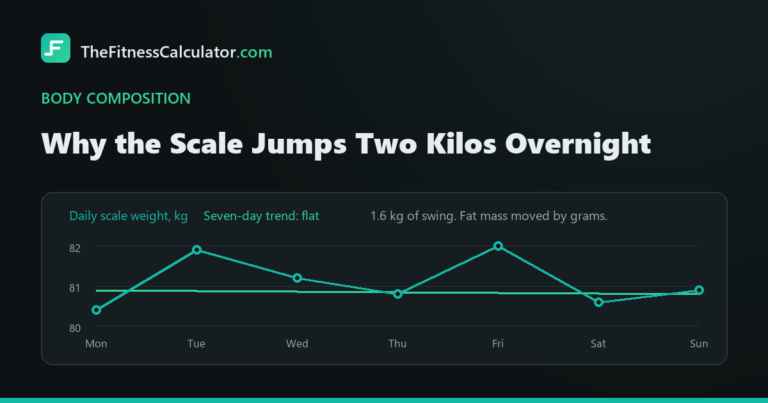
Hydration is most of the reason the scale moves overnight. Each gram of stored glycogen holds about 3 grams of water, so a low-carbohydrate day drops 1 to 2 kg that has nothing to do with fat. Why the scale jumps overnight covers the mechanism.
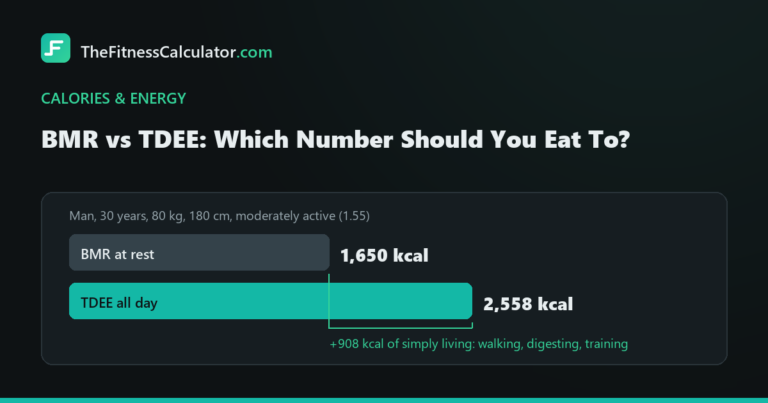
Drinking more water does not burn fat. It helps in two narrow ways. Thirst is easy to misread as hunger, and a glass before a meal has a small measurable effect on how much people eat at it. Neither effect is large enough to matter against the size of your energy deficit, which is the thing that decides the outcome. The calorie and TDEE calculator works out that number, and how big a deficit should be covers what to do with it.
One thing worth knowing before you start: increasing your intake will add weight for the first few days as your body settles at a new fluid balance. That is not a failed diet. Give it a week before reading anything into the scale.
Common questions
How much water should I drink a day?
Around 35 ml per kilogram of body weight, plus roughly 350 ml for every 30 minutes of exercise. A 70 kg adult who trains for half an hour lands near 2.8 litres. Heat, altitude, pregnancy and breastfeeding all push the figure up.
Is eight glasses a day the right target?
Eight 240 ml glasses comes to 1.9 litres, which is close enough for a small, sedentary adult and well short for a large or active one. The rule has no research behind it. It appears to trace back to a 1945 US Food and Nutrition Board note that also said most of that water comes from food, a sentence everyone dropped.
Do tea, coffee and food count towards the total?
Yes. Caffeinated drinks hydrate you on net despite the mild diuretic effect, and food supplies roughly 20 percent of most people's water intake. Fruit, vegetables, soup and yoghurt all carry a lot.
How do I tell if I am drinking enough?
Urine colour is the practical check. Pale straw means you are fine; dark amber means drink more. Thirst is a reliable signal for healthy adults, though it dulls with age, which is why older adults are told to drink on a schedule rather than on demand.
Can you drink too much water?
Yes, and it can be dangerous. Taking in more than the kidneys can clear, roughly a litre an hour sustained, dilutes blood sodium and causes hyponatremia. Endurance athletes who drink heavily during long events are the group most often affected.
How many ounces of water should I drink a day?
About 0.54 oz per pound of body weight before exercise is counted, so roughly 81 oz for a 150 lb adult and 113 oz for a 210 lb adult. Add around 12 oz for every 30 minutes of training. A standard bottle is 16.9 oz, so 81 oz is just under five of them.
Is 64 oz of water a day enough?
For a small, sedentary adult, yes: 64 oz is about what a 120 lb person who does not train needs. For a 190 lb person training half an hour a day the figure is closer to 114 oz, so 64 covers a little over half of it. The gap is usually made up by food and other drinks in a temperate climate, and is not made up during a summer training block.
Should I drink a gallon of water a day?
A gallon is 128 oz. That suits a large, active person in heat and is more than most people need. Spread across a day it does no harm, but there is no benefit in reaching a round number for its own sake.
 How Much Water You Actually Need Per DayEight glasses a day has no research behind it. The real numbers depend on your body weight, how much you sweat, and…
 Why the Scale Jumps Two Kilos OvernightYou ate well, trained hard, and woke up 1.8 kg heavier. Nothing went wrong. Here is what is actually moving, and how…
 BMR vs TDEE: Which Number Should You Actually Eat To?Your calculator gives you two numbers and they differ by 900 calories. One of them is a floor you should never eat…