Electrolytes: When Water Alone Is Not Enough
Sweat is not distilled water. It carries dissolved minerals, chiefly sodium and chloride, with much smaller amounts of potassium, calcium and magnesium. Replacing the water and ignoring the sodium is fine for an hour in an air-conditioned gym and a genuine problem across four hours in the heat.
How much sodium you actually lose
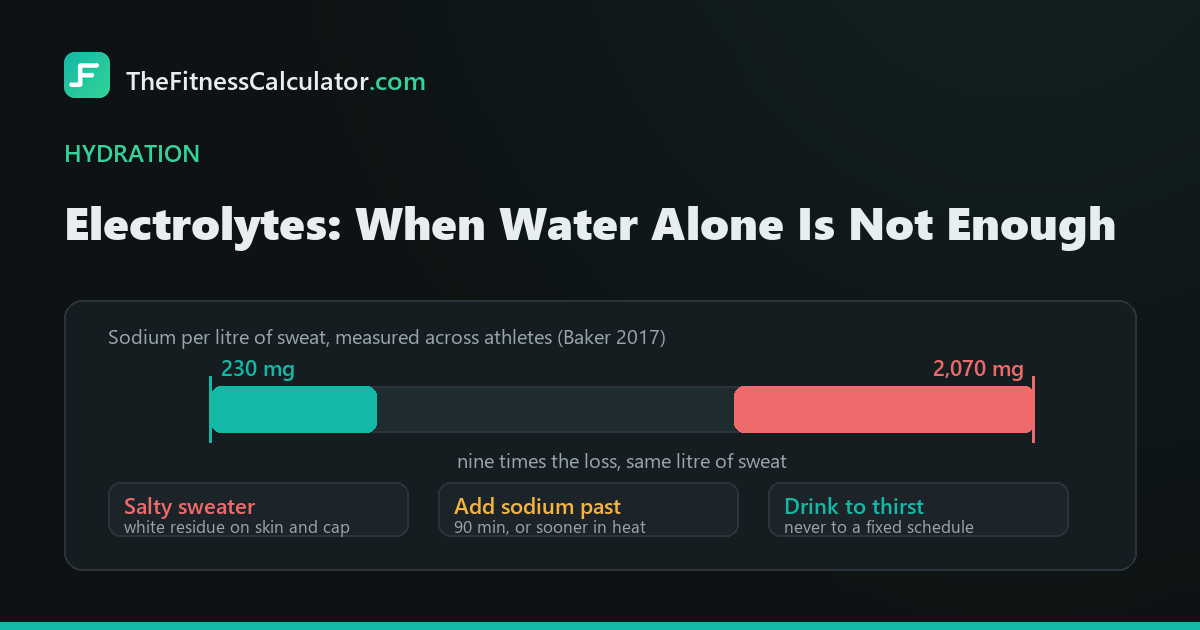
The variation between people is the part nobody prepares you for. A 2017 review in Sports Medicine collected the measurement data and reported sweat sodium concentrations spanning roughly 10 to 90 millimoles per litre, which is about 230 to 2,070 mg of sodium per litre of sweat. Sweat rates over the same population ran from under half a litre an hour to well over two litres.
Combine the two and one person doing a two hour session in the heat loses around 350 mg of sodium while another loses 6,000 mg. Generic advice cannot serve both, which is why most of it is useless.
Seventeen times the loss, same session, same weather.
You can identify yourself cheaply. White crusty residue on your skin, cap or dark clothing after training means high sweat sodium. Stinging eyes from sweat and a salty taste point the same way. No residue at all after a hard hot session means you are on the low end and can largely ignore this article.
When electrolytes are worth adding
- Continuous exercise beyond about 90 minutes, and sooner in heat or humidity.
- Visible salt residue after training.
- Sweat rates above roughly 1.2 litres an hour, which you can measure by weighing yourself before and after a session.
- Low carbohydrate or ketogenic eating, which increases sodium excretion through the kidneys, especially in the first few weeks.
- Illness with vomiting or diarrhoea, where losses are large and fast.
- Working outdoors in heat all day.
When they are a waste of money
A normal day at a desk, a 45 minute gym session, or a run under an hour in mild weather. A typical Western diet already supplies 3,000 to 4,000 mg of sodium a day, comfortably above what a sedentary body needs, and dinner replaces an ordinary training loss without any help.
Electrolyte tablets sold for hangovers, tiredness and general wellbeing are solving a problem most buyers do not have. Salt is cheap and already in your food. The water intake calculator already adds fluid for the exercise you log, and for most sessions that fluid is all you need.
The failure mode that actually hurts people
Exercise-associated hyponatremia is what happens when sodium in the blood is diluted by drinking too much plain water. It is rare, it is far more dangerous than dehydration, and it comes from following a schedule instead of a thirst signal.
People have died of it. Nobody has died of finishing a marathon thirsty.
The 2005 New England Journal of Medicine study of the Boston Marathon tested finishers and found 13% of them were hyponatremic. The strongest predictors were gaining weight during the race, a finishing time over four hours, and a low body mass index. Gaining weight over 42 km means the runner drank more than they lost.
The third international consensus statement on exercise-associated hyponatremia gives the prevention in one line: drink according to thirst rather than to a prescribed schedule. Confusion, headache, nausea and puffy hands during a long event are warning signs, and the response is to stop drinking and get help, not to drink more.
Practical amounts
For sessions past 90 minutes, aim for roughly 300 to 600 mg of sodium per litre of fluid, at the higher end if you are a salty sweater. Commercial sports drinks sit around 400 to 500 mg per litre. Making your own works too: a gram of table salt supplies about 390 mg of sodium, so a quarter teaspoon in a litre lands in range.
Food does the job for anything shorter. Salted nuts, olives, cheese, bread, a bowl of soup or a glass of milk all replace ordinary losses. Potassium comes from potatoes, bananas, beans and yoghurt, and deficits of it are uncommon in people eating vegetables.
Two cautions. If you are on blood pressure medication, have kidney disease or have been told to restrict sodium, none of this overrides your doctor. And salt tablets swallowed dry on an empty stomach cause nausea, so dissolve them.
Expect the scale to move when you change sodium intake, because sodium holds water. That is one of the mechanisms behind overnight scale swings, and it resolves in a few days. For the underlying daily fluid target, start with how much water you actually need per day and add sodium only where the list above says it earns its place. The full set of calculator guides covers the rest.