How Much Protein You Actually Need Per Day
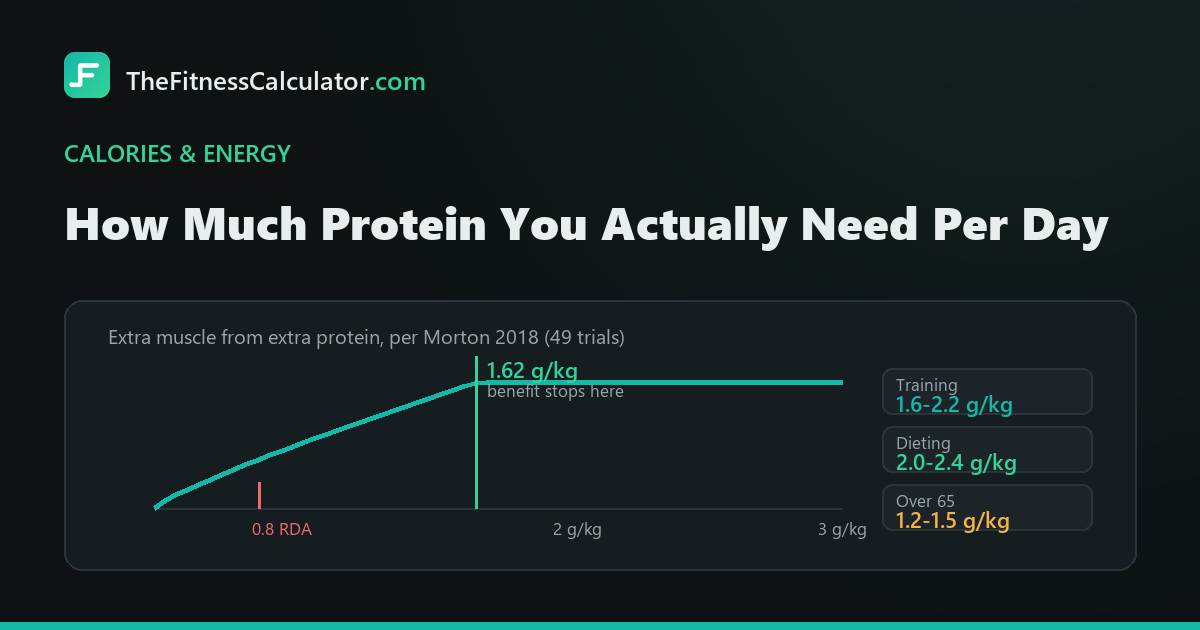
The official protein recommendation is 0.8 g per kilogram of body weight per day. That figure was set as the amount that prevents deficiency in a sedentary adult, which is a different question from the amount that builds muscle or protects it while you diet. Using the deficiency threshold as a training target is like setting your salary at the poverty line.
The number the training research keeps landing on
A 2018 meta-analysis in the British Journal of Sports Medicine pooled 49 trials and found that the benefit of extra protein plateaus at about 1.62 g per kilogram, with a confidence interval running up to 2.2. Eating more than that did nothing measurable for muscle mass or strength in the trials they had.
The International Society of Sports Nutrition’s position stand on protein and exercise puts the working range at 1.4 to 2.0 g/kg for anyone training regularly. For an 80 kg person that is 112 to 160 g a day. For a 60 kg person, 84 to 120 g.
Two groups sit at the top of the range or above it. Lean people dieting hard need more, because protein is what stops the body raiding muscle for fuel when food is short. And older adults lose the ability to respond to a given dose of protein, which is why the PROT-AGE group recommends 1.0 to 1.2 g/kg for healthy people over 65 and 1.2 to 1.5 for those who are ill or training.
Why it matters most when you are eating less
A 2016 trial in the American Journal of Clinical Nutrition took young men, put them in a 40% deficit for four weeks with resistance training six days a week, and gave one group 2.4 g/kg of protein and the other 1.2. Both lost fat. The high protein group gained 1.2 kg of lean mass while doing it. The low protein group gained 0.1 kg. Same deficit, same training, one variable changed.
That trial is also the strongest evidence that losing fat and gaining muscle at once is possible, and protein is what makes it possible.
So every sensible cutting plan raises protein rather than cutting it. If you are working out how big a deficit to run, set protein first and take the reduction out of carbohydrate and fat.
How to spread it across the day
Total intake does most of the work. Distribution is a second order effect, but it is a real one. Schoenfeld and Aragon’s 2018 review of how much protein the body can use in one sitting recommends four meals of roughly 0.4 g/kg each, which for an 80 kg person means about 32 g of protein four times a day. There is no upper limit at which protein stops being absorbed. What changes is how much of a single dose gets used for building tissue rather than burned for energy.
Practical portions that hit 30 g: 130 g of chicken breast, 150 g of tinned tuna, five eggs, 170 g of Greek yoghurt plus a scoop of whey, 200 g of firm tofu, or a cup of cooked lentils with a cup of rice.
The kidney question
The claim that high protein damages kidneys comes from people who already have kidney disease, where protein restriction is a real treatment. It was then applied to everyone else without evidence. A 2018 systematic review in the Journal of Nutrition pooled 28 trials and found no difference in kidney function between healthy adults on higher and lower protein diets.
If you have diagnosed kidney disease, this is a conversation for your doctor and none of the numbers above apply to you.
What high protein costs you
Protein is not free. It occupies calories that could have gone to carbohydrate, which fuels hard training, or fat, which carries hormone precursors and fat soluble vitamins. Pushing to 3 g/kg on a limited calorie budget squeezes both. That is the argument against going far past the plateau: no upside, and a real cost to the rest of the diet. It matters most in a gaining phase, where carbohydrate is doing the work in the gym.
Protein is a floor to clear, not a score to maximise.
Protein does have one useful side effect. It is the most filling of the three macronutrients per calorie, and the most expensive for the body to process, with roughly 20 to 30% of its energy lost to digestion against 5 to 10% for carbohydrate. Neither effect is large enough to build a diet on, but both help.
Setting your own number
Get your calorie target from the calorie and TDEE calculator, then take protein at 1.6 g/kg if you are eating at maintenance or gaining, and 2.0 to 2.2 g/kg if you are dieting or already lean. Multiply that by four to get the calories protein occupies, subtract it from your daily target, and split what is left between carbohydrate and fat however you prefer to eat.
If you carry a lot of body fat, calculate from a target weight rather than your current one. At 130 kg, 2 g/kg is 260 g of protein a day, which is neither necessary nor pleasant. Using a goal weight of 90 kg gives 180 g, which does the same job. The rest of the calculator guides cover where the other numbers come from.