How Much Water You Actually Need Per Day
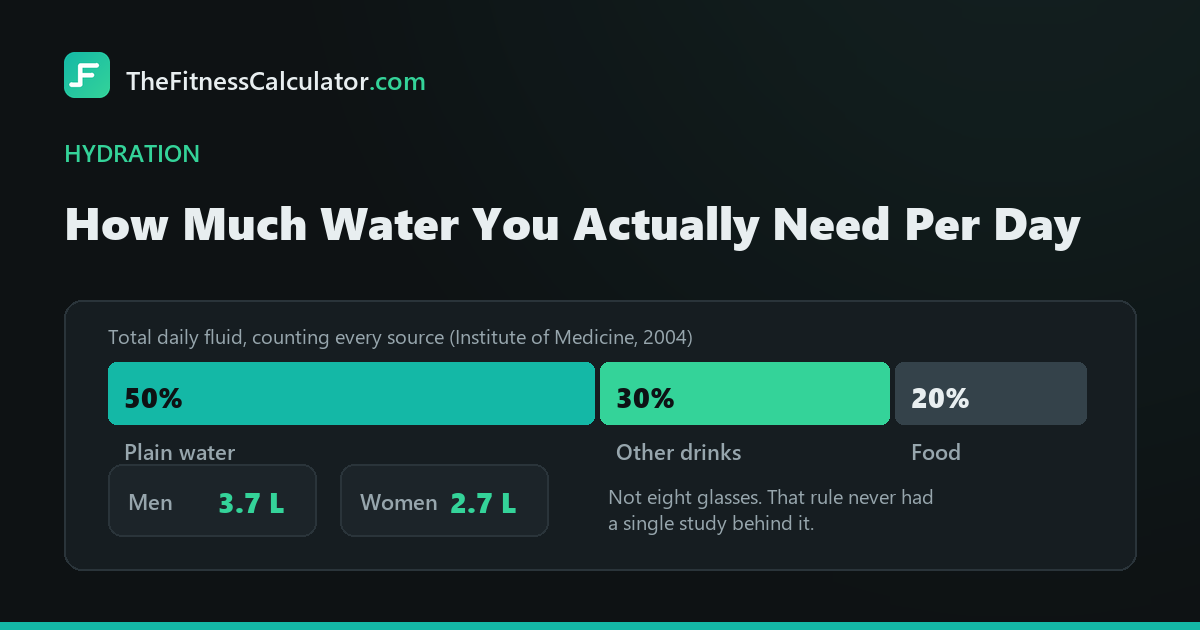
The eight glasses rule has no source. Investigators have traced it to a 1945 US Food and Nutrition Board recommendation that suggested about 2.5 litres of water a day for adults, followed immediately by a sentence noting that most of this quantity is contained in prepared foods. The second sentence dropped out, the first became a slogan, and it has been repeated for eighty years.
The actual reference figures
The Institute of Medicine ran a proper review in 2004 and set adequate intake levels for total water, meaning everything from drinks and food combined:
- Men: about 3.7 litres a day
- Women: about 2.7 litres a day
Roughly 20% of that arrives in food. Fruit, vegetables, soup, yoghurt and rice all carry substantial water; a cucumber is about 96% water and a bowl of porridge more than half. Subtract the food share and the drinking target lands near 3.0 litres for men and 2.2 litres for women, which is 12 and 9 cups respectively.
Coffee and tea count. The idea that caffeinated drinks dehydrate you does not survive contact with the evidence: the mild diuretic effect is smaller than the volume of fluid in the cup, so a mug of tea is a net gain. Alcohol is the genuine exception.
Scaling to your own body
Population averages are a poor fit for a 55 kg woman and a 105 kg man. A body weight estimate handles that better, and the common clinical heuristic is around 35 ml per kilogram of body weight. For an 80 kg person that gives 2.8 litres before any allowance for training.
The water intake calculator uses that 35 ml/kg base and adds roughly 350 ml for each half hour of exercise. Thirty minutes of training at 80 kg comes to 3.15 litres a day, or about 13 cups.
Sweat is the variable that matters
Exercise sweat rates run from about 0.5 litres an hour for light indoor work up to 2 litres an hour or more for hard efforts in heat. That range is wider than every other factor combined. A footballer in July and the same player in an air-conditioned gym in January have genuinely different requirements, and no fixed daily number covers both.
Weigh yourself before and after a session if you want a real figure. Every kilogram lost during training is roughly a litre of sweat, and replacing 125 to 150% of it over the following hours covers ongoing losses. If you are moving up an activity band, this is one of the practical consequences worth planning for, alongside the calorie changes covered in picking an activity multiplier.
Urine colour beats counting
Pale straw means you are fine. Dark amber means drink. Clear and copious means you are drinking more than you need, which is harmless for most people but pointless.
The one caveat is that B vitamin supplements turn urine bright yellow regardless of hydration, so if you take a multivitamin, judge by volume and frequency instead. Most well-hydrated adults pass urine every three to four hours during the day.
More is not better
Healthy kidneys clear roughly 0.8 to 1.0 litres an hour. Drink faster than that for long enough and blood sodium falls, which causes exercise-associated hyponatraemia. It is rare but real, and it has killed marathon runners, more often than dehydration has. Endurance athletes should drink to thirst and take sodium during long events rather than pre-loading water on a schedule.
Several groups need medical guidance rather than a calculator: anyone with heart failure or kidney disease on a fluid restriction, people on diuretics, and anyone pregnant or breastfeeding, whose requirements rise by several hundred millilitres a day.
Why your weight jumps when you change intake
Start drinking substantially more and the scale often rises a kilo in the first few days as your body settles into a new fluid balance. Cut carbohydrates and it falls two or three kilos in a week for the same reason in reverse. Neither movement is fat. Why scale weight swings overnight explains what is actually moving, and it is worth reading before you draw conclusions from any short run of weigh-ins, particularly if you are tracking a calorie deficit.