Picking an Activity Multiplier Without Fooling Yourself
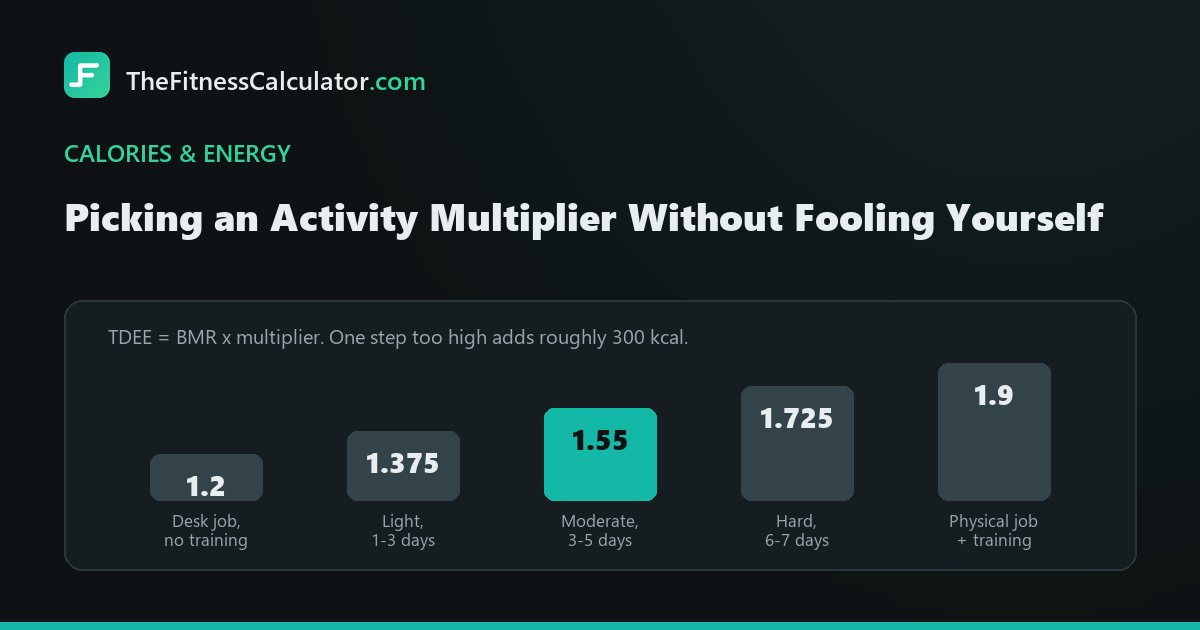
Every TDEE calculator asks you to place yourself in one of five activity bands, then multiplies your resting metabolic rate by a number between 1.2 and 1.9. For the 1780 calorie BMR in the worked example, the choice spans 2136 at the bottom and 3382 at the top. Over 1200 calories rides on a dropdown.
Most people choose one band too high. The labels are partly to blame, since "moderately active" sounds like a description of character rather than a measurement of output.
What each band actually means
- 1.2, Sedentary. Desk job, car commute, no structured exercise. Under 5000 steps on a typical day. This describes far more people than pick it.
- 1.375, Light. One to three training sessions a week, or a job with some walking. Roughly 5000 to 7500 steps.
- 1.55, Moderate. Three to five real sessions a week plus 7500 to 10000 steps. This is the calculator’s default and it suits a genuinely consistent gym-goer with an otherwise ordinary day.
- 1.725, Active. Six or seven sessions a week, or five sessions on top of a job that keeps you upright. Over 12000 steps.
- 1.9, Very active. Manual labour plus training, or twice-daily sessions. Roofers, movers, competitive endurance athletes in season.
Set your band with the calorie and TDEE calculator and note that the multiplier is meant to cover your whole week, including the days you do nothing. Two brutal sessions and five sedentary days is a light week, not an active one.
The part nobody counts
An hour in the gym is a small slice of a day. A 70 kg person lifting weights for an hour burns perhaps 250 to 350 calories, which is around 4 hours of sitting. What separates a 1.2 from a 1.55 is mostly everything outside training: walking, standing, stairs, chores, fidgeting.
Researchers call this non-exercise activity thermogenesis, and it varies enormously between people. Studies overfeeding volunteers by 1000 calories a day have found differences of several hundred calories between individuals in how much spontaneous movement increased. Some people pace; some sit still. You cannot pick which one you are, but you can count steps, which is why the step ranges above are more reliable than the labels.
Two corrections worth making
First, if you train hard but drive to a desk and sit for nine hours, you are lighter than you feel. A four session week on top of 4000 daily steps is closer to 1.375 than 1.55.
Second, activity levels drop in a deficit without anyone deciding to slow down. Eat 20% less for a month and you will take fewer steps, take the lift more often, and move less between sets. The multiplier you picked in week one is optimistic by week six, which is a large part of why weight loss stalls on a deficit that used to work.
Pick low and correct upward
Choosing a band one step below your instinct costs you very little. If you undershoot your true expenditure you lose slightly faster than planned, notice it in the weekly average, and eat more. Overshoot in the other direction and you spend six weeks wondering why nothing is happening.
Either way the multiplier is a starting guess, not a result. Two weeks of consistent eating and honest weigh-ins will tell you more than the dropdown ever can, and the guide to BMR and TDEE covers how to run that check.
One knock-on effect
Moving up a band changes more than calories. Training volume and daily movement both raise how much fluid you need, and the gap between a sedentary day and a two hour session is easily a litre. How much water you actually need per day handles the arithmetic.