BMR vs TDEE: Which Number Should You Actually Eat To?
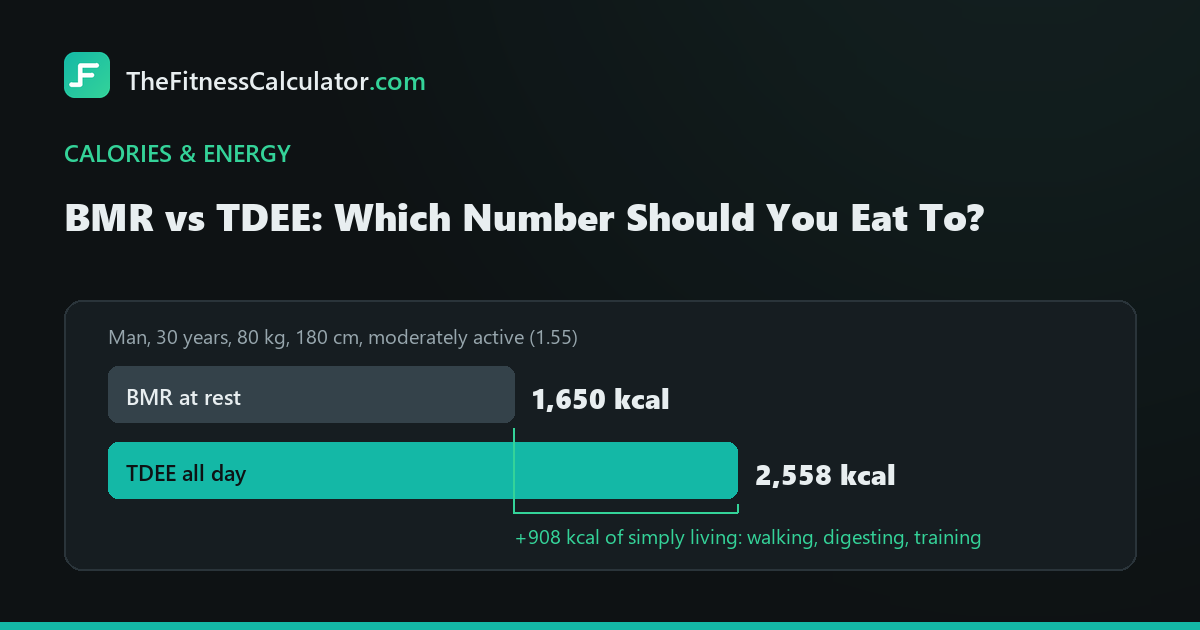
Run the calorie and TDEE calculator and you get two figures. A 30 year old man at 80 kg and 1.80 m who trains four days a week sees a BMR of 1780 and a TDEE of 2759. Nearly a thousand calories separate them, and people regularly eat to the wrong one.
BMR is the cost of being alive
Basal metabolic rate is what your body burns lying still, awake, fasted, at a comfortable temperature, doing nothing. Heart, lungs, kidneys, liver and brain account for most of it. The brain alone runs on roughly 20% of the total despite weighing about 1.4 kg.
The site uses the Mifflin–St Jeor equation, published in 1990 from measurements on 498 people:
- Men: (10 × weight in kg) + (6.25 × height in cm) − (5 × age) + 5
- Women: (10 × weight in kg) + (6.25 × height in cm) − (5 × age) − 161
It replaced the 1919 Harris–Benedict equation, which was built on a smaller and leaner sample and tends to overestimate modern bodies by 5% or so. A 2005 review by Frankenfield and colleagues compared the common equations against measured metabolic rates and found Mifflin–St Jeor landed within 10% of the true value for about 82% of non-obese adults, the best of the group.
Read that error bar carefully. Ten percent of 1780 is 178 calories, and one person in five sits outside even that. The equation knows your weight, height, age and sex. It does not know your thyroid function, your muscle mass or your genetics.
TDEE is BMR plus everything else you do
Total daily energy expenditure adds four things on top of BMR: digesting food, deliberate exercise, and all the movement that is neither, plus the small thermic cost of processing what you eat. The calculator handles this by multiplying BMR by an activity factor between 1.2 and 1.9.
That multiplier is the loosest part of the whole estimate, and picking the wrong one throws your target off by 400 calories or more. Choosing an activity multiplier honestly walks through what each band actually means in practice, and it is worth five minutes before you trust the output.
Never eat at your BMR
This is the mistake worth naming. People see two numbers, assume the smaller one is the safe target, and set a diet at 1780 while also training four days a week. That is not a modest deficit. Against a TDEE of 2759 it is a shortfall of roughly 980 calories a day, which is aggressive enough to cost you muscle, sleep quality and training performance within a few weeks.
BMR is a floor, not a target. It is the number below which your body is being asked to run its organs on less energy than they need. Set your intake against TDEE instead, and see how large a calorie deficit should actually be for the arithmetic on a sensible rate of loss.
Both numbers move as you do
Lose 10 kg and your BMR drops by roughly 100 calories, because there is less tissue to maintain. Your TDEE drops further, because moving a lighter body costs less and because most people unconsciously fidget and walk less when eating in a deficit. This is the main reason weight loss stalls at month three on a plan that worked in month one.
Recalculate every 5 kg or so rather than setting a number in January and defending it in June. If you are working toward a target weight, the ideal weight formulas and why they disagree is worth reading first, because most people pick a goal several kilos below anything the evidence supports.
What the numbers are worth
Treat the TDEE figure as a starting hypothesis, not a measurement. Eat at it for two weeks, weigh yourself under consistent conditions, and see what happens. If weight held steady, the estimate was good. If it moved, adjust by 200 calories and repeat. Your own two week trend beats any equation, since it accounts for the thyroid and the fidgeting and everything else the formula cannot see.
One caution when you check that trend. Scale weight is noisy enough that a fortnight is about the minimum useful window, for the reasons set out in why the scale jumps two kilos overnight.